Lore & Legend
The Lincoln Imp: The True History Behind Lincoln's Most Mischievous Legend
High inside Lincoln Cathedral, tucked among the magnificent stonework of the Angel Choir, sits a small figure with crossed legs, pointed features and a famously mischievous expression.
He is only about one foot tall, yet the Lincoln Imp has become one of the most recognisable symbols in the city. His image can be found on jewellery, souvenirs, signs, public art and in the identity of Lincoln City Football Club. He has represented local organisations, inspired generations of storytellers and travelled around the world in countless different forms.
According to the best-known legend, the Imp was a troublesome little demon who caused chaos inside the Cathedral until an angel turned him to stone. The true history is more complicated, and perhaps even more interesting.
The carving itself is genuinely medieval. The familiar story told about it appears to be much younger. Its transformation from a relatively obscure piece of cathedral stonework into the emblem of Lincoln owes something to medieval craftsmanship, but also to Victorian folklore, poetry, tourism and the extraordinary commercial success of a Lincoln jeweller named James Ward Usher.
This is the history of the Lincoln Imp, separating what can be documented from the stories that grew around him.
What is the Lincoln Imp?
The original Lincoln Imp is a carved stone grotesque inside Lincoln Cathedral. He sits high on the north side of the Angel Choir, near the eastern end of the choir, at the base of an elaborate leaf corbel.
The carving is approximately 30 centimetres, or 12 inches, tall. The figure is short and thick-set, with a shaggy or hairy body. One leg is crossed over the other, and both hands rest on the raised leg. He has small horns, large animal-like ears and cloven hooves. His face combines human and animal features, with a broad mouth that gives him his famous grin.
The figure is often casually described as a gargoyle, but that is not technically correct. A gargoyle is a carved waterspout designed to carry rainwater away from a building. The Lincoln Imp has no drainage function, so he is more accurately described as a grotesque, meaning a decorative carving of a strange, exaggerated or fantastical figure.
His position makes him easy to miss. He is high above ground level, surrounded by far larger architectural features and carvings. A spotlight now helps visitors locate him, but even then it can take a moment to spot Lincoln's most famous resident.
A 13th-century carving in the Angel Choir
The Imp belongs to one of the most important periods in the history of Lincoln Cathedral.
Construction of the Angel Choir began in 1256 and was completed in time for its dedication in 1280. It was built to provide a magnificent setting for the shrine of St Hugh of Lincoln, also known as Hugh of Avalon, who had been canonised in 1220.
The choir takes its name from the carved angels that fill the spandrels above its arches. The Lincolnshire Museums information sheet records 28 angels, together with representations of Christ and the Virgin Mary. The area also contains richly carved roof bosses, foliage, human figures, animals, monsters and grotesques.
The Lincoln Imp must therefore date from the late 13th-century construction of the Angel Choir. No surviving record identifies the individual mason who carved him, and there is no known medieval document calling the figure the Lincoln Imp.
This point is central to understanding his history. The stone figure is medieval, but the name and story by which he is now known are not securely documented from the same period.
Why would a devil appear inside a cathedral?
To modern eyes, it can seem surprising that a demonic creature would appear within one of the most sacred parts of a cathedral. In medieval church architecture, however, angels and saints regularly shared space with dragons, devils, hybrid animals, distorted faces and scenes of everyday life.
Grotesques could serve several purposes. Some may have acted as moral warnings, reminding worshippers of temptation, sin and the struggle between good and evil. Others were humorous, satirical or imaginative decorations. They also gave skilled stone carvers an opportunity to create figures beyond the more formal subjects required elsewhere in the building.
The Lincoln Imp is not the Cathedral's only demonic carving. Other horned heads and devil-like figures appear within the Angel Choir, while exterior carvings include further creatures associated with local legends. The Imp belongs to a much wider medieval visual world rather than being a lone demon inexplicably placed inside the church.
Lincolnshire Museums identifies him as a medieval depiction of a devil. Even so, the precise meaning intended by his creator remains unknown. It is possible that he symbolised evil contained within a holy place. It is equally possible that he was an imaginative decorative figure whose later fame far exceeded his original importance.
The famous legend of the Lincoln Imp
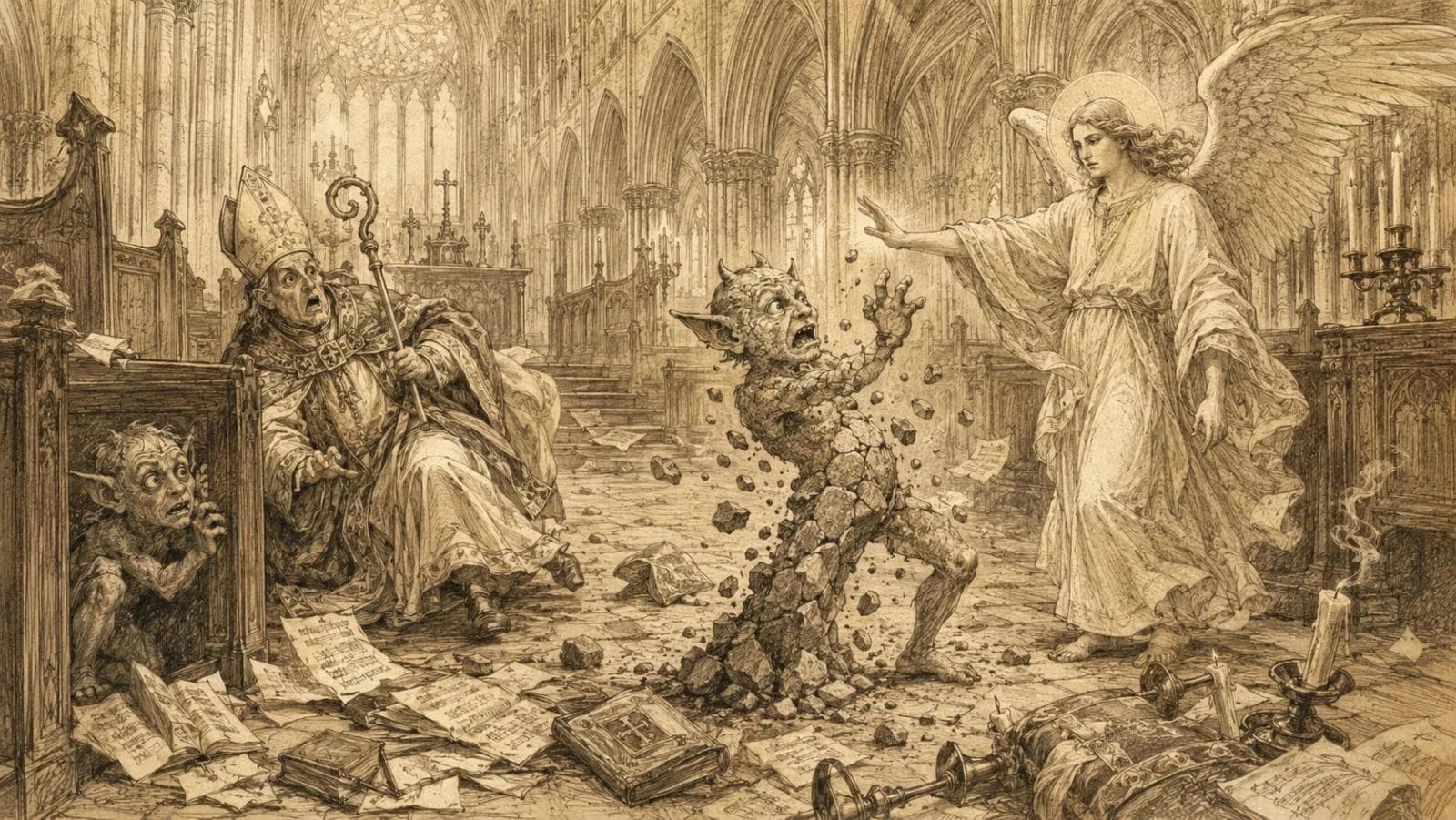
The best-known modern version of the legend begins when the Devil, feeling playful, sends two young imps into the world to cause trouble.
Blown towards Lincoln by the wind, the pair reach the Cathedral and begin creating chaos. They disturb the clergy, damage the building, break windows and put out the lights. An angel appears and orders them to stop.
One imp hides or retreats. The other refuses to behave. In some tellings, he throws stones at the angel. In others, he defiantly cries, 'Stop me if you can!'
The angel responds by turning the rebellious imp to stone. He is fixed high in the Angel Choir, where he remains as a warning against wickedness and disobedience.
The second imp escapes. According to the story, he continues to circle the Cathedral on the wind, waiting for his companion to return. This is said to explain why the area around Lincoln Cathedral is so often windy.
A popular modern variation says that the imps first visited Chesterfield and twisted the spire of the Church of St Mary and All Saints before travelling to Lincoln. Other versions connect the second imp with a weathered carving on the Cathedral's south side, the Grimsby Imp or an imp at Lincoln College, Oxford.
These variations are part of the nature of folklore. Stories change as they are retold, and unusual local features are gradually drawn into the same narrative.
Is the legend really medieval?
The carving is medieval. There is no firm evidence that the familiar legend is.
Research by the Arts and Humanities Research Council-funded Lincolnshire Folk Tales Project found no evidence that the recognisable Lincoln Imp story existed before the Victorian period. Cathedral guidebooks published well into the 19th century either ignored the carving or described it without using the name Lincoln Imp.
A Cathedral guide cited by Lincolnshire Museums and published in 1862 referred to the figure as an elf with large ears that might illustrate medieval folklore. It did not tell the story of two imps, a destructive rampage or an angel turning one of them to stone.
This does not prove that no oral story existed. Folk tales can circulate for many years without being written down. It does mean that the complete legend should not be presented as a documented story passed unchanged from the Middle Ages.
The most accurate conclusion is that the Lincoln Imp is a late 13th-century carving surrounded by a legend that took its recorded form during the late 19th and early 20th centuries.
That does not make the legend false in the way a mistaken historical date might be false. Folklore is not a court record. Its importance lies in how communities create, repeat and reshape stories. The growth of the Imp legend is itself a genuine part of Lincoln's history.
Older stories about the Devil, the wind and Lincoln
Although the familiar Imp story appears relatively recent, stories linking the Devil with Lincoln and its Cathedral are much older.
By the 17th century, writers were discussing the expression 'to look as the Devil over Lincoln'. It described a hostile, jealous or malicious look. One explanation connected it with a devil-like stone figure at Lincoln College, Oxford. Another argued that the saying originally referred to the Devil looking enviously upon Lincoln Cathedral and the Christian faith it represented.
A different local story explained the wind around the Cathedral. The Devil and the wind supposedly arrived together. The Devil asked the wind to wait outside while he went into the Cathedral to speak to the Dean and Chapter. The wind has been waiting for him ever since.
Another exterior sculpture, often called the Devil on the Witch's Back, was known and illustrated long before the small figure in the Angel Choir became famous. Early guidebooks paid attention to this exterior carving whilst overlooking the figure now recognised around the world as the Lincoln Imp.
These older traditions supplied many of the ingredients used in later Imp stories: the Devil, the wind, stone monsters, Lincoln Cathedral and the idea of evil looking upon a great Christian building.
The Victorian legend did not appear from nowhere. It brought older fragments together and gave them a memorable central character.
Arnold Frost and the legend in print
One of the earliest known printed narratives connecting the Cathedral carving with a devil-and-wind legend appeared in Arnold Frost's The Ballad of the Wind, the Devil and Lincoln Minster.
Frost's poem was in circulation by 1897, and a third edition was published in 1898. He stated that the work was based on an old Lincolnshire legend which had not previously appeared in print. He claimed that the story had been told to him around the beginning of the 1890s by a North Lincolnshire man in his sixties, who had heard it from his own father as a child.
Taken at face value, this account might push an oral version of the story back into the first half of the 19th century. There is no independent evidence confirming that lineage, so it should be treated as a possibility rather than a proven fact.
Frost's early version was not identical to the children's story commonly told today. It centred on the Devil's anger at Bishop Remigius and the building of Lincoln Cathedral. The Virgin Mary sent a mighty wind against the Devil, who took refuge inside the church. Frost then connected this tradition to the stone figure in the Angel Choir.
Later editions included further variants, including the idea of two imps and a second stone figure outside the Cathedral. Through Frost's work, separate Lincoln traditions became more closely associated with the little grotesque in the Angel Choir.
The figure now had a name, a role and a story.
H. J. Kesson and the story generations remembered
The legend received another major boost in 1904 with the publication of H. J. Kesson's illustrated poem The Legend of the Lincoln Imp.
Kesson's version presents the Imp as an energetic young demon carried to Lincoln on the wind. He boasts about the trouble he intends to cause, enters the Cathedral, behaves disrespectfully and eventually encounters an angel. The angel turns him to stone, giving the tale the clear moral ending familiar to generations of readers.
The booklet was repeatedly reprinted. Project Gutenberg's edition records reprints in 1907, 1911, 1919 and many further years through to 1944.
Kesson's lively verse helped establish the character of the Imp as he is now commonly imagined: boastful, cheeky, destructive and ultimately defeated by a greater power.
Repeated publication matters in the development of folklore. A story that appears in guidebooks, poems, illustrations and souvenirs can quickly begin to feel ancient, even when its best-known form is comparatively recent.
By the early 20th century, the distinction between the medieval age of the carving and the modern age of the legend had become blurred.
James Ward Usher and the rise of the Imp souvenir
The Imp's fame cannot be explained by storytelling alone. Jewellery and souvenirs placed his image into the hands of visitors and carried it far beyond Lincoln.
James Ward Usher was born in Lincoln on 1 January 1845. His father, James Usher, had opened a jewellery and watchmaking business on Lincoln High Street in 1837. James Ward joined the business in 1860 and took control in 1874.
Interest in the carving had already begun to grow. Lincolnshire Museums records that plaster casts of the Imp could be seen in local shops by 1874. Usher did not discover a completely unknown figure, but he recognised its commercial potential and transformed it into a distinctive Lincoln souvenir.
His firm produced Imp brooches, pins, cufflinks, spoons, thimbles and other objects. Some were made in precious metals and set with diamonds or other gemstones. The quality of the finest pieces helped turn a humorous local figure into a fashionable and collectable design.
A surviving certificate records the registration of Design No. 151149 on 20 June 1890 for a Lincoln Imp spoon. The registration granted five years of copyright protection for that design. Museum accounts also describe Usher as enjoying a temporary monopoly over Lincoln Imp jewellery.
This distinction matters. It is often said that Usher patented the Lincoln Imp itself. The surviving evidence is more specific: it includes a registered design for an Imp spoon, alongside museum descriptions of protected commercial use for a limited period.
Usher's advertisements promoted his firm as the originator of Lincoln Imp jewellery and warned customers against inferior imitations. Orders arrived from Britain and abroad. His association with the figure became so strong that letters addressed simply to 'the silversmith who makes and sells the Lincoln Imp' reportedly reached him. Another envelope bore only the word 'Lincoln' and a drawing of the Imp.
In modern terms, Usher turned the Imp into a remarkably successful piece of civic branding. Visitors could take home a character that was unmistakably connected with Lincoln, even if they had struggled to see the small original high inside the Cathedral.
From commercial success to the Usher Gallery
The Lincoln Imp helped bring James Ward Usher wealth and international recognition, but his legacy extends well beyond jewellery.
Usher was an enthusiastic collector of watches, clocks, ceramics, silver, enamels, coins and miniatures. When he died in 1921, he left his collection and a considerable sum of money to the city, with the intention that a gallery should be built to house it.
The Usher Gallery was completed five years later and officially opened on 25 May 1927. Its foundation is therefore closely connected with the commercial story of the Lincoln Imp. The success of the figure contributed to the fortune behind one of Lincoln's most important cultural institutions.
Original Usher Imp jewellery remains part of the Gallery's collections, including finely made brooches set with precious stones.
From medieval devil to good-luck charm
The meaning of the Imp changed as his popularity grew.
Within the medieval Cathedral, the figure was probably intended to represent a devil or demonic creature. On a brooch, spoon or charm, however, the same figure could become humorous, decorative or even lucky.
By the beginning of the 20th century, claims were circulating that Lincoln Imp jewellery could protect its owner from loss or bring good fortune. A folklore collection published in 1908 questioned whether this supposed belief was genuine old folklore or a modern sales device created to promote souvenirs.
Whether the lucky Imp began as advertising or popular belief, the new meaning endured. The threatening medieval devil became a cheeky companion and a reminder of home.
This ability to hold several meanings at once is part of the Imp's appeal. He can be a demon, a naughty child, a warning against bad behaviour, a lucky charm and a symbol of local pride.
The Imp spreads beyond Lincoln
When Usher's period of design protection ended, many other manufacturers adopted the figure.
During the early 20th century, Lincoln Imps appeared on china, brass pokers, toasting forks, bells, spoons and a wide variety of souvenirs. Some were carefully made pieces of jewellery. Others were inexpensive keepsakes designed for the growing visitor trade.
The Imp also acquired an Oxford connection. Lincoln College, Oxford, installed a relief of the Imp in 1899, probably replacing an earlier figure. A 1908 history of the College described it as Lincoln's 'overseer', adopted from the figure in the Angel Choir at Lincoln Cathedral. The earlier relief is now kept inside, whilst a replacement guards the Front Quad.
A later strand of folklore linked the two carvings by claiming that one imp was turned to stone in Lincoln while the other escaped to Oxford. This is a neat story, but the documented Oxford relief appeared only after the Cathedral figure had become popular in the late Victorian period.
The Imp has since travelled much further. Copies and adaptations have been produced around Britain and overseas, demonstrating how a very local image can acquire an international life.
How the Imp became the symbol of Lincoln
During the 20th century, the Imp moved beyond folklore and tourism to become a public symbol of Lincoln and Lincolnshire.
Lincoln City Football Club is widely known as the Imps, and the figure has long been associated with the club's identity. Its mascot, Poacher the Imp, turns the small stone carving into a life-sized matchday character.
Lincolnshire County Council has also used a stylised Imp in its visual identity, while local businesses, schools, societies and community organisations have adopted the name or image.
The figure continues to inspire public art. In 2021, the Lincoln Imp Trail placed 30 large Imp sculptures around the city, accompanied by up to 60 smaller Imps in an education trail. At auction, 31 sculptures raised more than £128,000 for St Barnabas Lincolnshire Hospice.
The project demonstrated how adaptable the character had become. The same basic figure could be medieval, playful, artistic, charitable and proudly local.
Few city symbols have followed such an unusual route. The Imp was not created as an official emblem. He became one through centuries of reinterpretation and public affection.
What does the Lincoln Imp represent today?
There is no single correct interpretation of the Lincoln Imp.
To a medieval viewer, a demonic carving may have represented temptation, disorder or evil held within the power of the Church.
To Victorian and Edwardian visitors, the Imp became an entertaining legend and a distinctive souvenir.
To generations of children, he is the naughty creature who challenged an angel and received an unforgettable punishment.
To football supporters, residents, artists and local businesses, he represents Lincoln itself.
His success lies partly in this ambiguity. He belongs to one of England's greatest medieval buildings, yet he does not feel remote or solemn. His crossed legs, compact body and knowing grin give him personality.
Lincoln Cathedral contains carvings of far greater size and religious significance, but it is this tiny figure, hidden high among the stonework, that has captured the widest public imagination.
How to find the original Lincoln Imp
The original Imp can be seen inside Lincoln Cathedral in the Angel Choir.
Look high on the north side of the choir, towards its eastern end. He sits cross-legged between the arches on one of the last columns before the east end. A dedicated spotlight helps visitors locate him.
Because he is high above the floor, binoculars or a camera with a zoom lens can reveal details that are difficult to see with the naked eye. His horns, ears, shaggy body, fingers and cloven hooves become much clearer when viewed closely.
It is also worth looking for the Cathedral's many other grotesques and unusual carvings. Seeing the Imp among his medieval companions places him back into the artistic world from which he came.
The enduring history of the Lincoln Imp
The history of the Lincoln Imp is not simply the history of a stone carving.
It begins with a medieval mason whose name has been lost. It continues through older traditions about the Devil, the wind and Lincoln Cathedral. Victorian writers brought those traditions together, poets gave the Imp a personality, and James Ward Usher carried his image around the world through jewellery and souvenirs.
The legend may not have survived unchanged from the 13th century. Instead, it did something just as characteristic of living folklore: it grew.
Each generation added something. The medieval craftsman gave the Imp his form. Storytellers gave him a past. Poets gave him a voice. Jewellers made him portable. The people of Lincoln made him their own.
More than seven centuries after he was carved, the Lincoln Imp still watches from his place in the Angel Choir, small, defiant and grinning over the city that adopted him.
Take home a modern piece of history
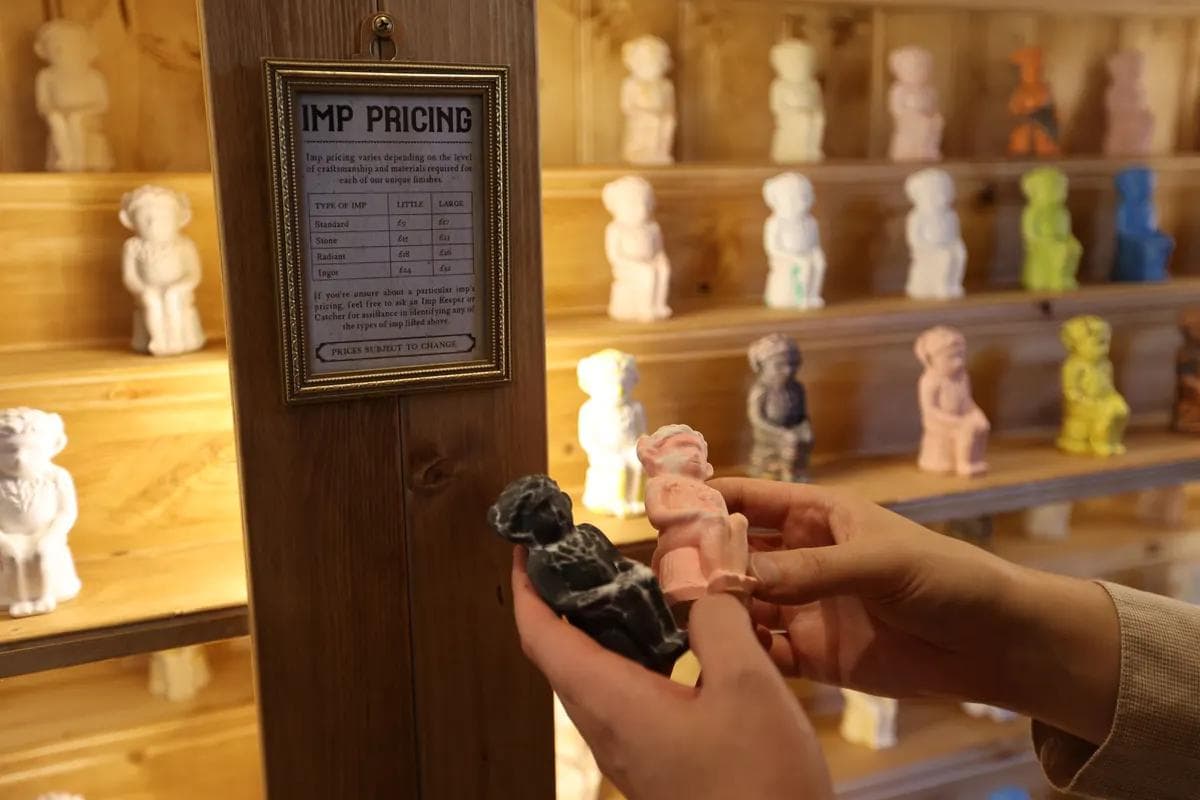
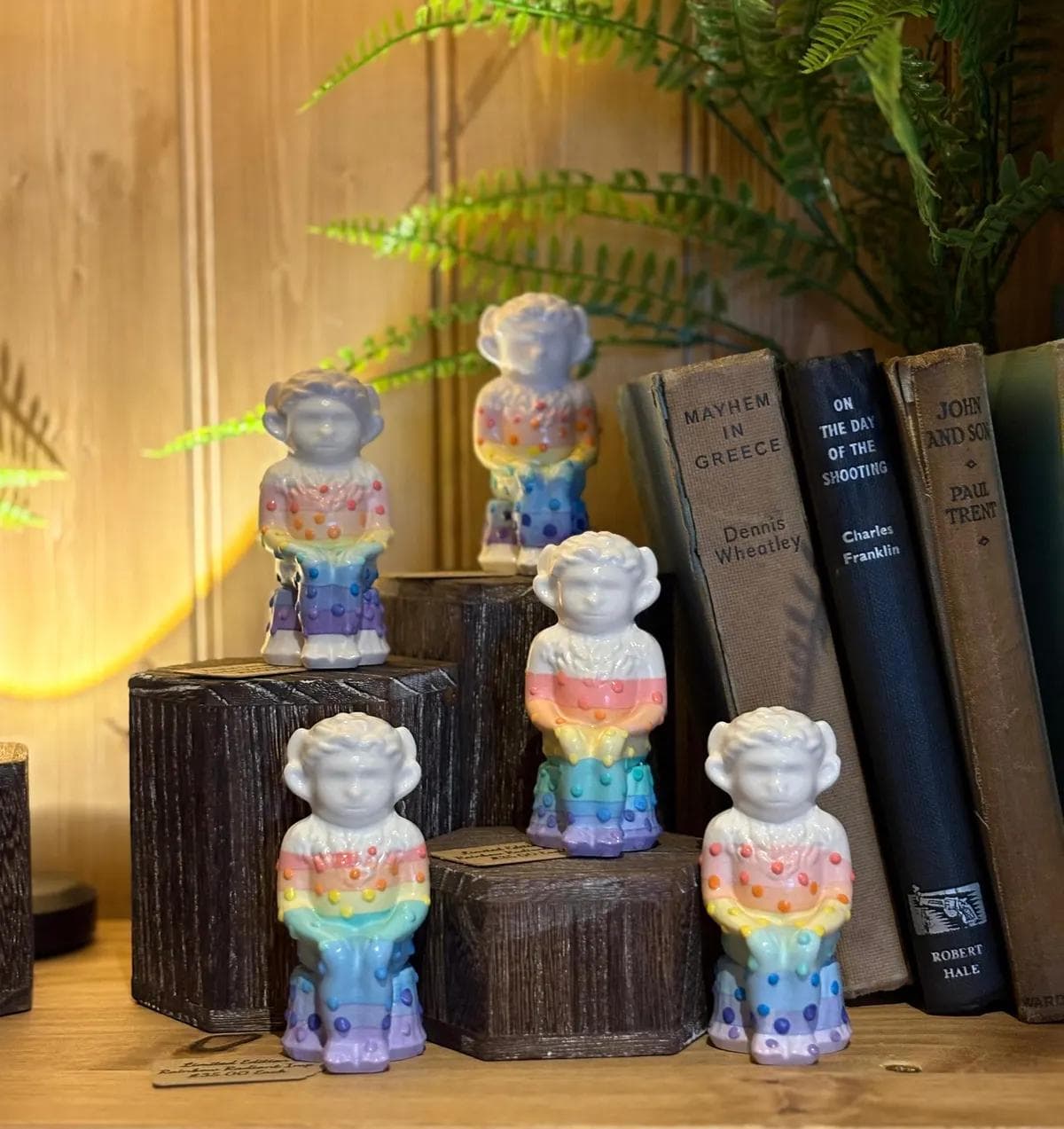
The story of the Lincoln Imp has always travelled through objects people can hold, treasure and take home. At the Lincoln Imporium, we continue that tradition with our own Lincoln Imps, handmade in Lincoln.
Whether you are remembering a visit, celebrating your connection to the city or choosing a gift with a story behind it, take home a modern piece of Lincoln history and let a little local mischief follow you home.
Discover the handmade Lincoln Imps at the Lincoln Imporium.
Continue reading
More from the Journal
The Collection
Take an Imp Home
Each piece in the collection is one of a kind, freshly unearthed from the workshops of Lincoln and waiting to be rehomed.
Enter the Shop